 Design & Consultancy Services
Comprehensive Capabilities
1. BMS Systems: Architecture & Engineering Scope

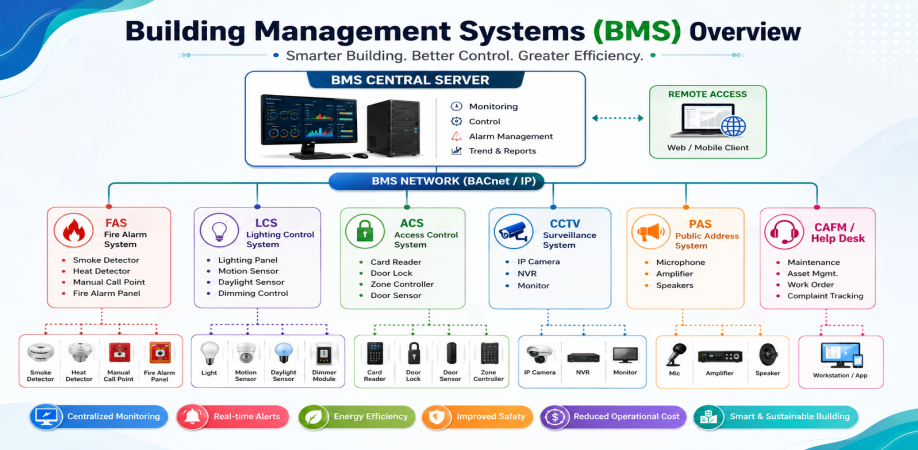
A Building Management System (BMS), also referred to as a Building Automation System (BAS), is an intelligent centralized control architecture engineered to monitor, supervise, and automatically regulate mechanical, electrical, and electromechanical services across large commercial, industrial, and institutional buildings. At Techno Apogee, our BMS design solutions integrate field Direct Digital Controllers (DDC), sensors, and actuators over open protocols—including BACnet IP/MSTP, Modbus RTU/TCP, and LonWorks—providing facility managers with an intuitive, unified SCADA dashboard for facility-wide command.
- Unified Protocol Architecture: Native communication between BACnet, Modbus, KNX, and MQTT for complete multi-vendor equipment interoperability.
- Distributed Intelligence: Autonomous DDC controllers execute local PID loops and fail-safe schedules independently of the central server.
- Real-Time 3D SCADA Interface: Dynamic graphics representing floor plans, central chiller plants, AHUs, and electrical single-line distribution.
2. Functions of BMS Systems
The primary functions engineered into our BMS systems deliver complete automated control over energy-intensive building sub-systems:
- Chiller Plant Staging & Optimization: Dynamic chiller sequencing based on cooling load demand, condenser water reset, and cooling tower VFD fan modulation.
- Air Handling Unit (AHU) & VAV Regulation: Modulating chilled water valves, static duct pressure resets, and Demand Controlled Ventilation (DCV) based on indoor CO2 ppm sensors.
- Automated Lighting Management: Daylight harvesting, astronomical clock schedules, corridor occupancy sensing, and load shedding during peak hours.
- Electrical Sub-Metering & Power Quality Telemetry: Real-time monitoring of main low-voltage switchboards, busbar trunking (BBT) tap-offs, power factor correction (PFC) banks, and generator status.
- Critical Alarm Escalation: Automated instant SMS, email, and audible alarm broadcasts for high motor winding temperatures, water leakage, or phase imbalances.
3. Importance & Necessity of BMS Systems Design
In modern industrial and commercial facilities in Bangladesh, operating HVAC and electrical systems without an engineered BMS results in 25% to 35% wasted electrical and thermal energy. Unmonitored chillers and AHUs run continuously at partial loads, leading to excessive energy bills, equipment wear, and frequent breakdowns.
A professionally engineered BMS provides precise operational visibility, reduces utility overheads, satisfies BNBC 2020 energy efficiency standards, and enables facilities to qualify for international LEED (Leadership in Energy and Environmental Design) Platinum and Gold certifications. Furthermore, BMS predictive maintenance telemetry extends primary equipment lifespan (MTBF) by an estimated 28%.
4. Design Process of BMS Systems
Techno Apogee executes BMS engineering through a rigorous, multi-stage design workflow adhering to ASHRAE Guideline 13 and BNBC provisions:
- Stage 1: Mechanical & Electrical Load Audit: Comprehensive site survey identifying all chillers, cooling towers, pumps, AHUs, FCUs, boilers, generators, and switchboards requiring telemetry.
- Stage 2: Input/Output (I/O) Point Schedule Preparation: Detailed mapping of all Universal Inputs (UI), Digital Inputs (DI), Analog Outputs (AO), and Digital Outputs (DO) for every piece of equipment.
- Stage 3: Control Schematics & Riser Architecture: Generation of comprehensive CAD control loop diagrams, DDC panel internal layouts, power distribution, and BACnet/IP network riser schematics.
- Stage 4: Cable Schedule & Conduit Pathway Engineering: Sizing and routing of shielded twisted-pair (STP) control cables, separation from high-voltage lines, and containment specifications.
- Stage 5: Sequence of Operations (SOO) & Functional Matrix: Authoring exact algorithmic control logic for seasonal operation, night setbacks, fire alarm emergency shutdown interlocks, and smoke management.
- Stage 6: Testing, Commissioning & SAT Protocol: Factory Acceptance Testing (FAT), on-site point-to-point loop testing, sensor calibration, and comprehensive As-Built documentation handover.
5. Applicable Sectors for BMS Systems
Our engineered BMS designs are deployed across critical infrastructure sectors throughout Bangladesh:
- Export RMG & Textile Mega-Mills: Precise temperature and relative humidity stabilization in spinning, knitting, and dyeing sheds with central ETP telemetry.
- Pharmaceutical & Healthcare Facilities: cGMP-compliant cleanroom differential room pressure control, cascade airlock interlocks, and 21 CFR Part 11 electronic logging.
- Commercial Grade-A High-Rises: Centralized chiller plant automation, multi-tenant energy sub-metering, and corporate headquarters comfort regulation.
- 5-Star Hotels & Luxury Resorts: Unified control of central chillers, banquet hall air handling, swimming pool heat pumps, and guestroom GRMS integration.
- Mission-Critical Data Centers: Dual-redundant CRAC/PAC precision cooling sequencing, hot-aisle containment monitoring, and UPS telemetry.
Organizations That Implemented This Solution