 Automation & BMS Solutions
Comprehensive Capabilities
1. PABX Systems: IP Telephony Architecture & Scope

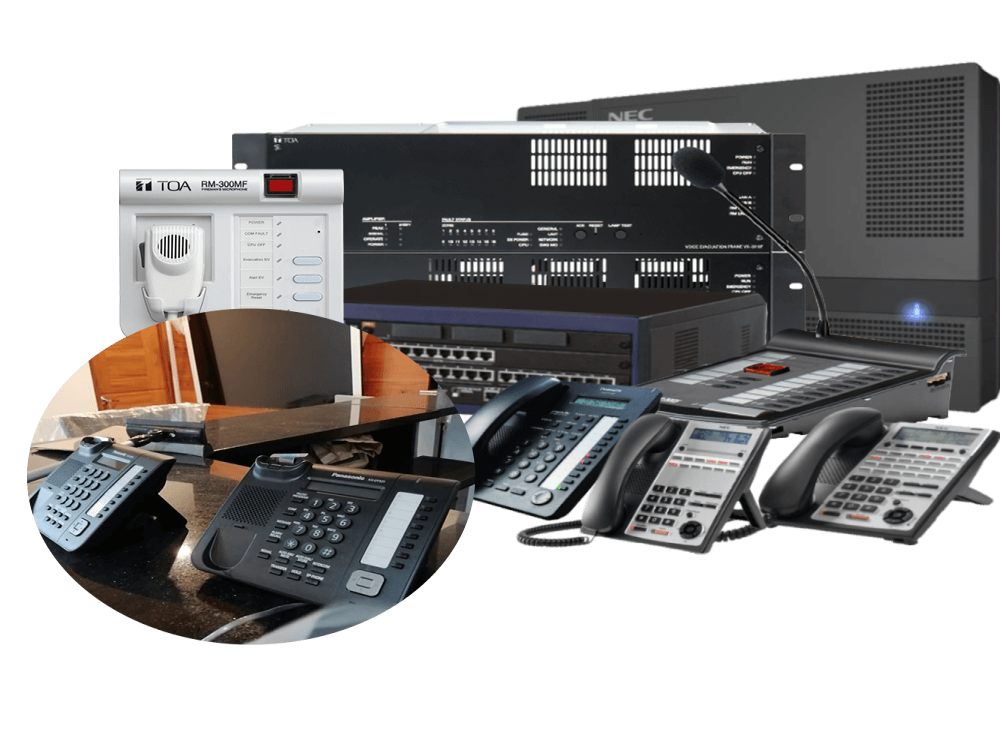
An IP PABX Systems Design converges traditional public telephone networks (PSTN, E1/PRI, GSM) with modern Session Initiation Protocol (SIP) VoIP communications over standard computer data networks. Replacing legacy copper wire telephone exchanges, our IP PBX platforms allow desk phones, reception attendant consoles, and smartphone softphones to communicate effortlessly over structured Cat6 Ethernet infrastructure without requiring dedicated telephone cabling.
2. Functions of a PABX System Design
Our IP telephony designs incorporate comprehensive enterprise voice capabilities:
- Multi-Level Interactive Voice Response (IVR): Automated digital auto-attendant greeting callers and routing them efficiently to departments.
- Automated Call Distribution (ACD) & Queues: Intelligent call distribution routing incoming customer inquiries to available agents.
- Free Multi-Branch Inter-Office Calling: Interconnecting head office and remote factory plants over secure VPNs for 100% free extension calls.
- Centralized Call Recording & Archival: Policy-driven audio recording of incoming/outgoing calls for quality assurance and training.
- Mobile Softphone Integration: Permitting executive and sales teams to make and receive office extension calls from smartphones anywhere globally.
3. Importance & Necessity of a PABX System Design
Organizations operating multiple industrial plants, sales depots, and corporate offices incur massive monthly telephone expenses calling between branches on traditional telephone lines. Legacy analog exchanges also suffer from noise, lightning damage, and expensive proprietary expansion boards.
A professionally designed IP PBX reduces internal corporate calling expenses to zero Taka by routing voice packets across existing broadband internet. Outbound mobile calls routed through GSM gateways cut external mobile telephone bills by up to 45% while ensuring crystal-clear G.722 HD voice clarity.
4. Design Process for PABX Systems
Techno Apogee engineers telecommunication systems through structured engineering steps:
- Stage 1: Traffic Modeling & Concurrent Call Analysis: Sizing Busy Hour Call Attempts (BHCA) and concurrent call capacity to determine required SIP trunk and IP PBX appliance scale.
- Stage 2: Extension Numbering Plan Architecture: Creating a unified 3-digit or 4-digit hierarchical dialing plan for departments, executive cabins, and remote factories.
- Stage 3: Gateway & Telco Interfacing Schematics: Designing physical interfacing for BTCL PSTN lines, digital E1/PRI ISDN lines, GSM SIM banks, and licensed IP-TSP SIP trunks.
- Stage 4: Voice VLAN & QoS Network Provisioning: Configuring DSCP priority queuing on managed network switches to prevent voice jitter and packet loss.
- Stage 5: IVR Scripting & Call Flow Programming: Setting up multi-lingual greetings, night-mode schedules, ring groups, and voicemail-to-email routing.
- Stage 6: Attendant Console & Station Commissioning: Deployment of executive Gigabit IP phones, reception sidecars, and user operational training.
5. Applicable Sectors for PABX Systems
Our IP telephony designs serve diverse corporate and industrial environments:
- Commercial Hotels & Hospitality Resorts: 100 to 500+ extension systems integrating guestroom phones, PMS billing, and wake-up alarms.
- Export Garment & Textile Mills: Intercom networks linking security gates, production floors, cutting rooms, and management suites.
- Corporate Multi-Storey Headquarters: Unified communications supporting hybrid office desk phones and mobile workforces.
- Hospitals & Diagnostic Centers: Rapid emergency paging, doctor consultation lines, and "Code Blue" one-touch hotline intercoms.
- Banking Head Offices & Customer Call Centers: High-capacity inbound queues with live supervisor whisper, barge-in, and analytics.
Organizations That Implemented This Solution